
A Scene That Never Made It Into My Script
How One “Unforgivable” Moment Nearly Destroyed The Great American Werewolf Story, and Ended Up Saving It

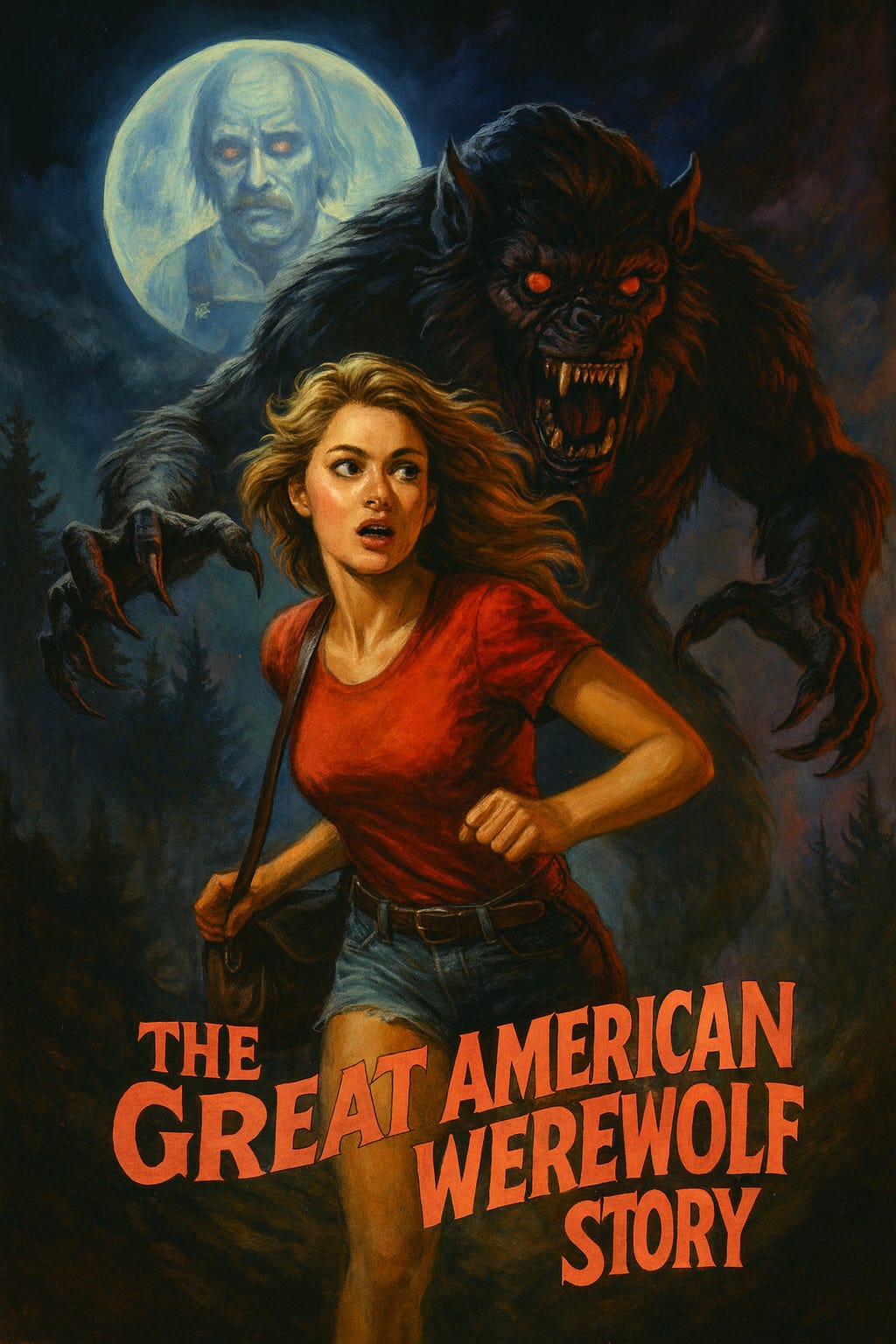
When I was first drafting The Great American Werewolf Story, I wrote a scene that broke one of horror’s oldest taboos: the werewolf ate a little boy.
Yeah, I know, there’s a golden rule in horror: never kill a dog or a child. You can decapitate a dozen teenagers, drown a corrupt sheriff, or turn an adulterer into ground meat, but the second you hurt an innocent kid or a loyal pet, the audience turns on you.
But in my mind at the time, I wasn’t thinking about rules. I was thinking about impact. I wanted my werewolf to feel dangerous in a way audiences couldn’t laugh off. Not just another creature tearing through nameless victims in the woods. I wanted to make people feel unsafe. So I wrote that scene.
And man, did it backfire.

The Shock That Killed the Story
When I sent the early draft out for feedback, I got a mix of confusion and disgust. One reader said it “ruined the entire story.” Another called it “perverted.”
At first, I was defensive. I thought, What do they know? Horror is supposed to push buttons. It’s supposed to get under your skin, right? If it doesn’t make people uncomfortable, it’s not doing its job.
But there’s a fine line between discomfort and disconnection, and I had crossed it.
The scene didn’t just make readers uncomfortable; it broke their emotional link to the story. It turned off their empathy instead of amplifying it. What was supposed to make my werewolf terrifying just made the story feel hollow.
I realized later that I wasn’t scaring people, I was alienating them.

Horror That Hurts vs. Horror That Heals
Great horror, the kind that lasts, doesn’t just shock. It exposes something raw in the human spirit. Think about the way Jaws used fear of the ocean to explore control and helplessness, or how It used childhood trauma to haunt us well into adulthood.
The best horror mirrors the things we already fear, and it gives those fears a face.
My version, at that point, had no face, just fangs. I wanted to make people gasp, but not feel. And that’s where I failed.
Looking back, I think that’s where a lot of young filmmakers and writers stumble. We chase the scare instead of the soul. We forget that horror isn’t about the kill, it’s about the connection that makes the kill matter.
I wasn’t writing a werewolf story; I was writing a scene that existed for shock value, and it showed.

The Rewrite That Changed Everything
When I finally cooled down and looked at the story again, I saw the truth: the script wasn’t working. It had a few jump scares, some cinematic bloodshed, and a cool concept, but no heart.
So I made one simple change that transformed the entire thing.
I replaced the little boy with a little girl. And she lived.
It sounds minor, but that one decision changed the DNA of the story.
Instead of the werewolf being a mindless killer, the creature became something tragic, almost protective. The relationship between the girl and the beast became the emotional backbone of the script, a fragile connection between innocence and monstrosity.
Suddenly, readers weren’t disgusted. They were moved.
What started as a brutal horror piece evolved into something layered, still scary, still brutal, but now full of humanity. It became a story about survival, empathy, and what it means to face the beast both outside and inside yourself.

Why the Scene Didn’t Work
It took me a while to understand why that original scene failed so miserably. It wasn’t because it was “too dark.” Darkness can be powerful when handled with care. It failed because it didn’t earn its darkness.
Killing a child on screen or page can work, films like It, Pet Sematary, and The Mist prove that. But those moments work because they come from emotional truth. The child represents innocence, and their death carries meaning beyond the shock.
My scene didn’t mean anything yet. It was just violence without context. It didn’t reveal character or deepen theme. It existed purely for reaction, and reaction fades fast.
In a way, the story punished me for not respecting its emotional core.

The Power of One Small Change
That rewrite taught me one of the most important lessons in storytelling: one small change can transform the entire soul of your story.
Change the gender of a character. Let someone live instead of die. Reverse the roles of victim and villain. Sometimes the difference between a forgettable scene and a haunting one isn’t massive rewrites, it’s seeing the heart you missed the first time.
The little girl brought compassion into a world of chaos. Her survival forced the audience to engage instead of recoil. She became the mirror for the werewolf’s lost humanity, and in that reflection, the story found its pulse.

The Power of One Small Change
That rewrite taught me one of the most important lessons in storytelling: one small change can transform the entire soul of your story.
Change the gender of a character. Let someone live instead of die. Reverse the roles of victim and villain. Sometimes the difference between a forgettable scene and a haunting one isn’t massive rewrites, it’s seeing the heart you missed the first time.
The little girl brought compassion into a world of chaos. Her survival forced the audience to engage instead of recoil. She became the mirror for the werewolf’s lost humanity, and in that reflection, the story found its pulse.

The Power of One Small Change
That rewrite taught me one of the most important lessons in storytelling: one small change can transform the entire soul of your story.
Change the gender of a character. Let someone live instead of die. Reverse the roles of victim and villain. Sometimes the difference between a forgettable scene and a haunting one isn’t massive rewrites, it’s seeing the heart you missed the first time.
The little girl brought compassion into a world of chaos. Her survival forced the audience to engage instead of recoil. She became the mirror for the werewolf’s lost humanity, and in that reflection, the story found its pulse.

Lessons From the Cutting Room Floor
I still keep that deleted scene in my old drafts folder. I don’t delete it entirely. I look at it sometimes, not out of nostalgia, but as a reminder of what storytelling really demands, humility.
You don’t always get it right the first time. Sometimes your “big shock moment” is really your weakest link. And sometimes the fix isn’t rewriting fifty pages, it’s rewriting your intention.
Horror is not cruelty. It’s empathy wearing a mask.
And the longer I write in this genre, the more I realize that’s the difference between splatter and soul.
The Heart Beneath the Howl
So if you’re a horror writer or filmmaker reading this, someone tinkering with your own monsters and mayhem, don’t be afraid to go too far. But also, don’t be afraid to pull back. The key is knowing why you’re crossing the line.
Do it for truth, not for attention.
That’s the lesson The Great American Werewolf Story taught me.
The scene I cut ended up becoming the heartbeat of the story, the part that lives in the shadows but gives everything else life. And that’s the beauty of storytelling: sometimes the thing you kill off creatively is the thing that ends up saving you.
Because in the end, the scariest thing about horror isn’t the monster on screen, it’s realizing that every time you write one, you’re facing the one inside yourself.
I love The Great American Werewolf Story . It’s an excellent script . Glad you changed the scene and I agree the monsters we face can lie within ourselves . This script was very moving and stirred emotions. Love Love Love It !!