
Stop Paying for Script Notes You Can’t Afford Build a Smarter AI Story Doctor Instead
Stop Paying for Script Notes You Can’t Afford Build a Smarter AI Story Doctor Instead

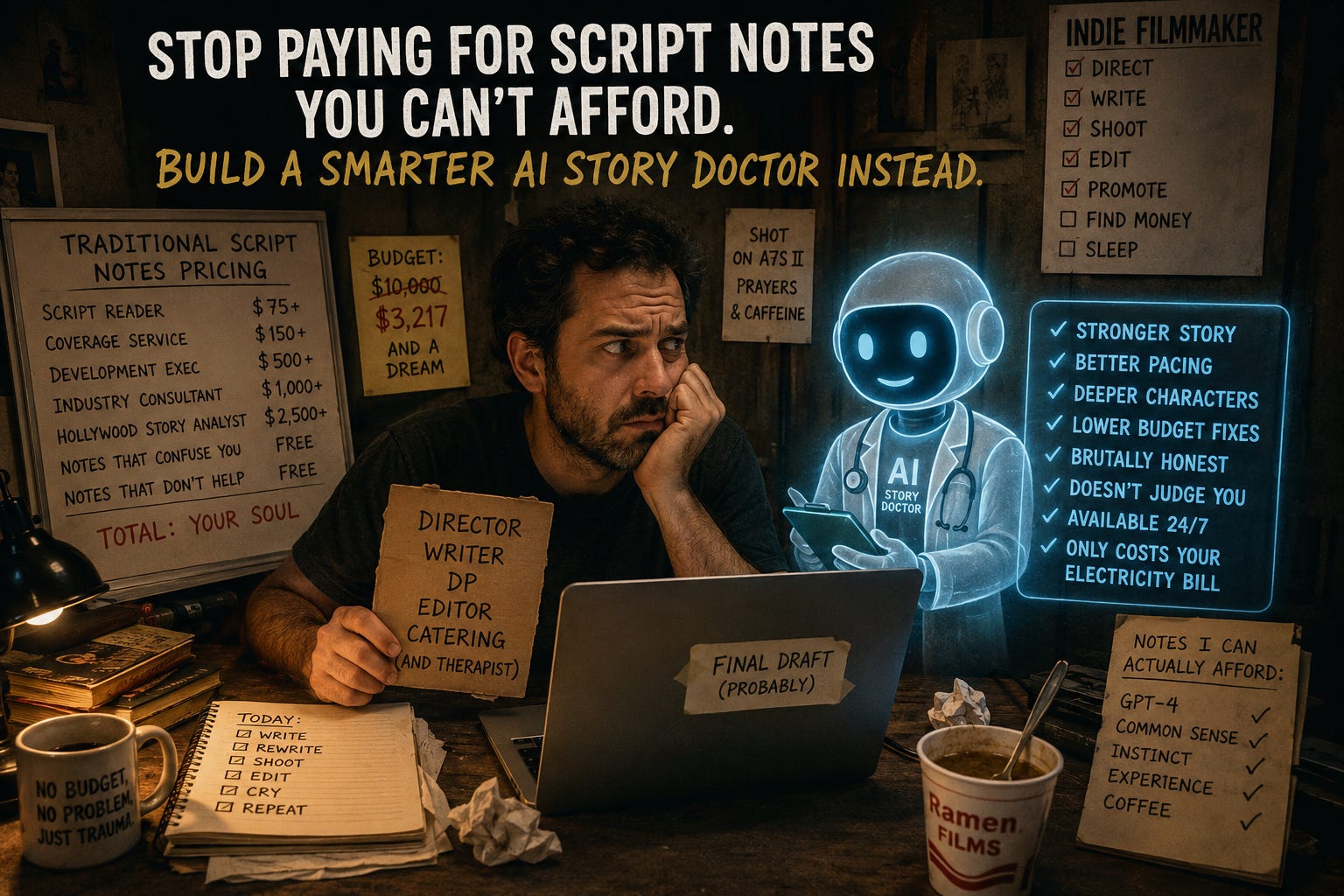
The first time I hired a script doctor, I learned something nobody tells you going in: script coverage is written for a world that does not exist in microbudget filmmaking.
The notes were fine. Technically correct. Professionally formatted. And almost completely useless.
“The third act needs more visual spectacle.” Sure. With what money?
“Consider a location shift to increase emotional scope.” Great idea. My location budget was zero.
That experience stuck with me for years, and it came back to me recently when I started experimenting seriously with AI as a development tool. Because here is the thing — most AI screenplay prompts have the exact same problem. They are written for a theoretical filmmaker who has no budget constraints, no scheduling limitations, and no reality to answer to. You ask an AI to analyze your script, and it comes back sounding like a junior assistant at a mid-level production company, giving you notes that could apply to any screenplay ever written about anything ever.
Vague. Generic. Disconnected from what it actually costs to make a movie.
I got tired of it. So I built something better.
The Problem With Generic AI Script Notes
When you type “analyze my screenplay” into an AI chatbot, you are essentially asking a brilliant person with no filmmaking experience to read your script and tell you what they think.
They will notice things. Real things. Story problems, character weaknesses, pacing issues, the AI will find all of it. But then it will hand you solutions that belong in a completely different conversation.
The notes do not know you are shooting in your cousin’s farmhouse in rural Tennessee with three actors, a borrowed camera, and a sound guy who also happens to be your grip.
They do not know that “add a chase sequence” costs you days of shooting and permits and insurance you cannot afford.
They do not know that your monster needs to stay mostly off-screen because your practical effects budget ran out after the hand puppet.
The problem is not the AI. The problem is the prompt. A generic input produces a generic output. And for independent filmmakers ,especially microbudget filmmakers, generic is the same as useless.
The fix is specificity. You have to give the AI a character to play. Not just “story doctor.” You have to give it constraints, priorities, reference points, and a mindset. You have to make it think the way a real producer thinks when they are looking at a $5,000 film headed toward production next month.
What I Built and Why It Works
I spent time developing three professional-grade AI screenplay analysis prompts, each calibrated for a specific production reality.
Not three versions of the same vague note-generator. Three completely different analytical frameworks were built around what it actually costs to make a film at each level.
The $5,000 Ultra-Microbudget Prompt approaches your screenplay the way the Blair Witch team would have with guerrilla instincts, practical location thinking, and an obsessive focus on atmosphere over spectacle. It forces the AI to think about what your two-room cabin can do that a $140,000 production cannot.
The $140,000 Serious Indie Prompt takes the Ti West approach. This is the level where you have a real crew, SAG actors, and a legitimate festival and distribution strategy. The notes here are about making something visually cinematic and emotionally devastating within real indie constraints.
The $6 Million Studio/Streaming Prompt operates in Jordan Peele territory. The framework here is built around commercial viability, franchise potential, marketing hooks, and what it takes to survive development at a real production company.
Each prompt forces the AI to think simultaneously like a development executive, a producer, a line producer, and a story doctor at the same time. That combination is what makes them work. Most screenplay prompts only activate one of those voices. The development executive voice gives you craft notes. The producer voice gives you budget reality. The line producer voice gives you scheduling problems. The story doctor voice gives you emotional architecture. You need all four in the same room, speaking at the same time, about your specific film.
A Note About AI and Your Ideas
I know some writers are worried about AI stealing their concepts. I understand the anxiety. But here is where I land on it personally.
Just about every idea has already been done. What makes your work yours is not the premise. It is the voice. It is the execution. It is the specific combination of your life, your obsessions, your sense of humor, your fear, and your weird fixation on that one image that you cannot get out of your head.
AI cannot steal that from you. It can help you shape it. It can help you stress-test it. It can help you find the structural problems before you spend six months rewriting the wrong version of your story.
Use the tools. Keep your voice. Know the difference between a note that makes your film better and a note that makes your film someone else’s film.
That is the skill. That is what working filmmakers do.
How to Use These Prompts
Simple process. Paste the prompt into your AI of choice, Claude, ChatGPT, whatever you are working with. Then paste your screenplay directly after it, or upload it as a document if the platform supports that.
The key is to use the right version for your actual production reality. Do not run the $6 million prompt on a film you are shooting in your backyard next month. Do not run the $5,000 prompt on a screenplay you are trying to take to a streaming platform. Match the analytical framework to the actual world your film lives in.
Read the notes with a producer’s eye. Not every note will be right for your specific vision. But the framework will catch things that generic AI coverage misses entirely, budget problems, scheduling nightmares, scenes that are cinematically expensive for no dramatic reason, character moments that are underdeveloped in ways that will hurt your actors.
These are not magic. They are a professional analytical framework that happens to be free to use. That is a real resource for independent filmmakers who cannot afford a real script doctor.
The Three Prompts Subscriber Exclusive Below
The three prompts below are the full professional versions. Each one is ready to use. Copy them, save them, put them in a folder you will actually find again.
This is the kind of resource that used to cost independent filmmakers real money. A single round of professional script coverage runs anywhere from $75 to $500, depending on who you hire and how fast you need it. These prompts will not replace a great human script doctor; nothing will. But they will get you a lot closer to production-ready than you would be otherwise. Let me know if you want more articles like this.
The prompts are available to paid subscribers. If you have been thinking about upgrading, this is a good week to do it.
