
The Future of AI Filmmaking: How Artificial Intelligence Is Transforming Independent Film (Part 1)
by Kevin Frasure assisted with ChatGpt research tool

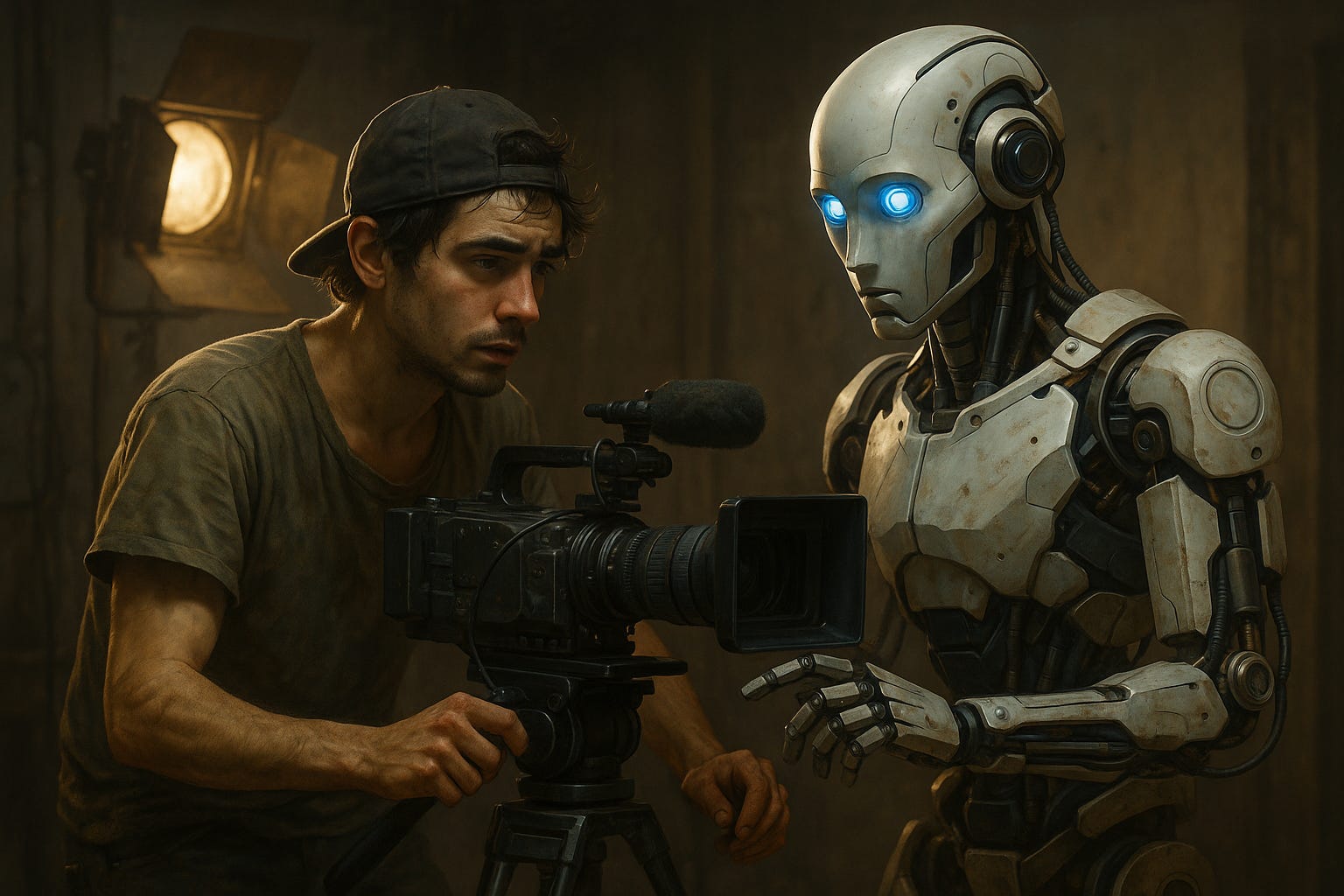
Picture this: a young filmmaker sits in a dimly lit room, eyes fixed on a laptop screen. With a few keystrokes, she conjures a bustling sci-fi cityscape and characters who only exist because she imagined them. No studio backlot, no massive crew – just an indie creator and an arsenal of artificial intelligence. This isn’t science fiction; it’s happening now. AI is emerging as perhaps the most transformative force in cinema since the advent of digital streaming. And unlike previous tech shifts that mainly empowered big studios, this revolution is democratizing who gets to tell stories. “There are a lot of gatekeepers right now to getting anything greenlit or distributed. The more that AI is high-quality and responsible, the more great stories get told,” one AI expert noted, highlighting how these tools are throwing open the gates for independent filmmakers.
In Hollywood’s golden years, the idea of a lone creator rivaling a studio was fantasy. Today, an AI-powered indie filmmaker can generate worlds, characters, and visual effects from a home computer that would have required teams of artists and millions of dollars not long ago. Generative AI – tools that create content from prompts – can now assist with everything from writing scripts to editing footage. It’s reshaping each stage of filmmaking in real time, blurring the line between the big-budget and the no-budget. How is this possible? To find out, let’s explore how AI is currently reshaping film production, post-production, screenwriting, visual effects, and distribution. We’ll look at the cutting-edge tools making it happen (Runway, Pika, ElevenLabs, Sora and more), real-world examples of innovators riding this wave, and the ethical compass guiding responsible use. The result is a hopeful outlook: a future where any indie creator with a story to tell can harness AI as a creative ally – and where human imagination remains firmly in the director’s chair.
Writing the Future: AI in Screenwriting and Concept Development
Every film begins as an idea, and AI is becoming the brainstorming partner of choice for many independent creators. Generative AI is enabling filmmakers to generate scripts, storyboards, and even entire scenes autonomously, helping a lone writer or small team punch above their weight. For instance, the latest breed of large language models (think of advanced versions of ChatGPT) can spitball plot ideas, suggest dialogue options, or instantly summarize a rough draft into a logline. Rather than replace human screenwriters, these AI co-writers act like an ultra-knowledgeable sounding board – one that never tires or runs out of suggestions at 3 a.m. when inspiration runs dry. This can be a godsend for an indie filmmaker developing a screenplay in isolation. Got writer’s block? An AI can propose ten ways to unstick the scene. Need research on historical details or a quick character backstory? It’s at your fingertips. The key, as early adopters have learned, is to remain the author and use AI as a creative catalyst, not a crutch. The Writers Guild of America (WGA) seemingly agrees: in its 2023 contract, the WGA explicitly affirmed that AI cannot receive writing credit or replace a human writer, but writers are free to use AI tools with consent, and any AI-generated material provided to a writer will not undermine their compensation or creditperkinscoie.comperkinscoie.com. In other words, the writer stays in the driver’s seat, with AI as a powerful assist – a stance that ensures human creativity and authorship aren’t erased even as we embrace these new tools.
Beyond the script pages, AI is also supercharging pre-visualization and storyboarding – those early concept stages where a filmmaker blocks out the look and flow of a movie. Time was, if an indie creator wanted storyboards or concept art, they’d either sketch stick figures or hire an artist. Now, anyone can generate detailed concept images by typing a description into tools like Midjourney or DALL·E. Need a moody cyberpunk alley or a Victorian-era ballroom for your pitch deck? Generative image AIs can produce multiple options overnight. In fact, directors are already using AI to whip up shot-by-shot storyboards in the planning phase: agentic AI solutions can produce detailed storyboards or mockups, helping filmmakers “see” their movie before a single frame is shot. This accelerates development tremendously. Indie producers with limited budgets can iterate on visual ideas without spending a cent on art departments or location scouts – AI can suggest what a scene might look like in a desert, or under rain, or in neon-soaked downtown Tokyo, all from a text prompt. As one McKinsey report highlighted, “pre-vis doesn’t yield a clear shot list, it creates more difficulty later... With AI, you can A/B-test shots before you shoot them, saving time on set and enabling more creativity once cameras roll”. In practice, that means a creator can test different camera angles or lighting schemes via AI-generated imagery and refine their vision long before they rent equipment or call actors to set. It’s the “fix it in pre” mentality – solving problems in the planning stage that used to only be discovered (at great expense) in post-production.
AI is also stepping into the nuts-and-bolts of pre-production logistics that are critical but often tedious. Script breakdown – the laborious task of combing through a screenplay to tag every character, prop, costume, and location for scheduling and budgeting – can now be largely automated. Specialized tools like SceneOne use AI algorithms to read a script and identify all the elements in each scene, generating breakdown sheets in minutes. No more color-coding scripts with highlighters until dawn; an indie producer can get a reliable rundown of everything needed for the shoot at the click of a button. Even the industry’s leading screenwriting software, Final Draft, has integrated AI under a feature called Final Draft Assist, which suggests script refinements and generates smart breakdowns of scenes. A writer can accept or reject suggestions to punch up dialogue or tighten a scene’s pacing, while a producer can quickly pull reports on how many locations or speaking roles are in the script. This bridging of creative and practical AI assistance ensures that from the first draft to the shooting schedule, indie filmmakers have extra help. It’s like having a savvy script analyst and a production manager embedded in your writing software. The result? Less time on grunt work, more on creative work. The entire development cycle speeds up and errors (like forgetting a prop or miscounting scenes) are reduced. For independent films where small mistakes can blow the whole budget, this kind of AI-driven diligence is a game-changer.
The Director’s New Assistant: AI on Set and in Production
When it comes time to actually shoot a film, AI’s role becomes a bit more behind-the-scenes – but it’s still very much present, quietly empowering indie filmmakers to achieve shots and logistical feats they might not otherwise manage. One immediate impact is in virtual production. Big studios have famously used wall-sized LED screens powered by game engines to create live backgrounds (as seen in The Mandalorian), but that tech is filtering down. Today, an independent creator might use Unreal Engine on a laptop to pre-visualize camera movements in a digital environment or even project AI-generated backdrops behind actors, blending real and virtual in real-time. While a full LED volume stage is still costly, smaller setups with projectors or greenscreens combined with AI background generation are emerging. For example, Adobe’s Firefly AI can generate background plates on demand; one filmmaker at Adobe MAX’s Generative AI Film Festival used real-time AI-generated backgrounds during live action shooting, allowing instant creative changes on set – “swapping environments or adjusting focal length, right on set” as Dave Clark described. This means a resourceful indie can shoot an actor on green screen and test different AI-created locations or set extensions on the fly, deciding in-camera what looks best. It’s the kind of flexibility that used to require massive resources, now available to micro-budget productions through smart use of AI.
Then there’s the intriguing new frontier of AI actors and stunt doubles. We’re not quite at the point where a director can yell “Action!” to a purely AI-generated performer on set – but we’re getting closer. AI-driven character animation tools are making it possible to film a scene with a stand-in and later replace them with a digital character, without motion-capture suits or manual keyframing. A leading example is Wonder Studio, a tool from Wonder Dynamics (recently acquired by Autodesk in 2024) that uses AI to automate exactly this process. An indie filmmaker can shoot a take with a human performing roughly how a CG character should move; afterward, Wonder Studio’s AI will track the actor’s performance and apply it to a computer-generated character – animating, lighting, and compositing the CG figure seamlessly into the scene. This eliminates the need for traditional motion-capture gear or a team of animators, dramatically lowering the barrier to convincing creature effects or robot co-stars. It’s a bit like having an invisible VFX team working in the cloud as you film. Imagine a no-budget sci-fi short where the protagonist’s alien sidekick is just the director’s friend in a morphsuit on set, but in the final cut that friend is replaced by a lifelike alien creature, moving and emoting with all the nuance of the original performance. Independent sci-fi and fantasy projects – once nearly impossible without Hollywood backing – are now within reach thanks to tools like this. In fact, Wonder Studio’s impact has been so significant that even Steven Spielberg and other Hollywood veterans invested in it to speed up VFX for everyone. If it’s good enough for Spielberg’s money, you can bet indie creators are putting it to use to realize bold visions that were previously out of scope.
AI is also lending a hand in more mundane but crucial aspects of production: budgeting and scheduling optimization. Indie filmmakers live and die by their shooting schedule – each day on set costs money and every lost hour hurts. Generative AI can analyze historical production data and script details to suggest the most cost-effective scheduling of scenes, or flag budget items that seem off. For instance, if your indie film has three nighttime street scenes, an AI scheduling assistant might suggest shooting them back-to-back to avoid multiple night equipment rentals (something a rookie AD might overlook). On the budgeting side, machine learning models trained on film budgets and box office data can give early projections: does your script with five locations and two battle scenes look like a $100K production or a $1M one? Are there particular scenes driving cost that, if rewritten slightly, would save thousands? In one summary of AI’s growing role, it was noted that AI algorithms can analyze production costs and audience data to guide cost-effective strategies, helping independent filmmakers make the most of their limited funds. While a spreadsheet and savvy producer can do some of this, AI can crunch far more variables (weather, traffic patterns, cast availability, even social media trends for marketing) to fine-tune a plan. The upshot is that small teams feel bigger – a theme we hear often from AI-positive creators. As one Reddit discussion aptly put it, “They make small teams feel bigger. They cut down production time. They can help indies compete”.
Even camera equipment is starting to quietly leverage AI. Modern mirrorless cameras and drones often have AI-based tracking and scene recognition that simplify difficult shots. An indie director can program a drone to track an actor through the woods using AI vision, achieving complex cinematography that used to require a seasoned cameraperson. Some cameras now offer AI-powered focus pulling and smart framing to keep subjects perfectly composed without a dedicated operator. These might seem like minor conveniences, but on a skeleton crew, having the camera itself assist in getting the shot can mean the difference between useable footage or a wasted shooting day. And if that weren’t enough, AI is also listening in: smart sound gear can monitor audio on set and automatically filter out a sudden plane noise or balance levels, alerting the team in real-time if a line was muffled. It’s as if every department – camera, lighting, sound – has an AI trainee working alongside your human crew, quietly catching mistakes and handling routine tasks so the humans can focus on creative decisions. The result is a leaner, nimbler production. Independent filmmakers are accomplishing in days what used to take weeks, or achieving shots that simply would’ve been impossible without a studio behind them.
Post-Production Alchemy: Editing, VFX and Sound with AI
If AI is a helpful assistant during production, in post-production it becomes a full-fledged wizard. This is where the technology truly shines for independent film: taking raw footage and transforming it into polished cinema with a speed and sophistication that feel a little like magic. Generative AI is revolutionizing the post-production and editing workflows, from cutting together scenes to adding visual effects, sound design, and color grading. The goal is not to remove the human editor or artist from the process, but to eliminate drudgery and expand creative options. And for indies, it often makes the impossible possible, allowing tiny post-production teams to achieve results on par with far larger operations.
Consider video editing, traditionally a painstaking process of sorting through hours of takes, finding the best moments, trimming and arranging clips on a timeline, and adjusting the pace by feel. AI is learning how to shoulder some of that workload. For instance, modern editing software now offers features like auto-assemble or AI rough cut, where the program can analyze your footage (using cues like dialogue transcripts or even emotional tone) and propose an initial cut of a scene. It won’t be perfect – an experienced editor still supervises and tweaks – but it can speed up the first pass dramatically. Adobe Premiere Pro, as of 2025, has integrated AI tools to do things like automatically remove filler words and silences based on the transcript of an interview, saving documentary makers countless hours, or to realign shots to match a soundtrack beat if you want to cut a music montage. And for complex tasks like matching the color tones between shots or stabilizing shaky footage, AI analysis is often one click away. The micro-tasks that used to absorb late nights in the edit bay – say, manually masking a boom mic that dipped into frame or rotoscoping a distracting background element – can now be handled by features that extend or clean up shots algorithmically. Studios report 80-90% efficiency gains in certain VFX prep tasks like removing unwanted objects or creating background extensions with these AI-assisted tools. For an indie, that can mean the difference between scrapping a shot because you can’t afford to fix it, versus salvaging it in seconds thanks to an AI effect.
It’s in the realm of visual effects (VFX), though, that AI truly levels the playing field. Once the domain of giant render farms and armies of specialists, VFX is becoming more about clever prompts and affordable cloud services. One breakthrough has been generative AI’s ability to create imagery and even full video from text descriptions. Services like Runway ML made headlines by introducing text-to-video generation (their Gen-2 model) in 2023, and they’ve iterated quickly with Gen-4 now enabling consistent characters and worlds across multiple shots. What does that mean for an indie filmmaker? It means if you need a cutaway shot of, say, a wide aerial of a fantasy castle or a spaceship taking off, you might literally type what you need and let AI generate a few seconds of footage, instead of hiring a VFX artist to model and animate it. Runway’s Gen-4 model is particularly geared towards narrative filmmaking – it can take a reference image (perhaps a sketch of your main character, or a photo of your filming location) and then generate new shots that maintain the style, subjects, and lighting consistently. Essentially, it gives you a controllable universe of AI footage to supplement what you shot. Filmmakers tested Gen-4 by making entire short films with it to push its storytelling capabilities. The result isn’t flawless photorealism (yet), but it’s often blendable with live action. In fact, Gen-4 emphasizes “production-ready” video, with improved motion realism and world understanding to better integrate with real footage. This points to an exciting workflow: shoot your principal actors on green screen, then use AI to generate the exotic backgrounds or even minor characters. Or film a scene practically, but if a prop is missing or the sky looks dull, use AI to paint in the difference. The days of “we’ll fix it in post” are turning into “AI will fix it in post” – and quickly.
We can already see these techniques in action. In early 2023, the VFX YouTube collective Corridor Digital stunned the internet by releasing an anime-style short film created with AI. They filmed themselves performing a live-action sequence, then used a fine-tuned Stable Diffusion model to repaint every frame in the style of a hand-drawn anime, effectively achieving a look that would normally demand a team of animators. The workflow was painstaking to develop, but the execution was largely automated by the AI once set up. Anime Rock, Paper, Scissors, as the short is called, became proof that with ingenuity and AI, a small team could produce something that looked like full-blown animation. (It also sparked heated debate about art ethics – more on that later – but as a technical milestone it was huge.) Frame from Corridor Digital’s AI-animated short film, created by feeding live-action footage through a fine-tuned Stable Diffusion model. Crucially, Corridor’s experiment showed that AI can unlock styles and scales of storytelling that were off-limits to indies: want to make an animated series but can’t draw? Now you can. Want to include a giant monster in your movie but can’t afford CGI? Maybe AI can sketch it into your scene believably. Another example: The Frost, a short horror film on YouTube, used generative AI to create surreal nightmare visuals layered onto live action, giving a single creator the ability to make a creature feature that punches well above its budget. And at the Runway AI Film Festival (AIFF) – yes, there is now a festival dedicated to AI-assisted filmmaking – the winning shorts range from a poetic meditation on memory to a dystopian sci-fi, all made by small teams leveraging these tools. It’s telling that Runway’s festival is co-presented with established institutions like Tribeca and IMAX, and the finalists are screened in theaters. This isn’t some fringe fan art scene; AI-crafted cinema is stepping onto real-world stages, showing what happens when indie creativity meets cutting-edge tech.
Alongside video, AI is revolutionizing post-production sound – often the secret sauce of a professional-grade film. Take dialogue and voiceover: thanks to AI, an indie creator no longer needs to hire expensive voice actors for every role or language. Tools like ElevenLabs have developed text-to-speech so lifelike that you can generate a performance in dozens of accents and languages at the press of a button. Their platform can clone voices (with consent) or provide a library of synthetic voices that capture a wide range of emotions. In fact, ElevenLabs has been so successful in mimicking human nuance that even big names like Matthew McConaughey and Michael Caine have inked deals to create AI replicas of their voices for authorized use. For an independent filmmaker, that means you could have narration delivered in a rich baritone “movie trailer” voice without ever entering a recording booth – or create a temp voiceover with the exact tone you want and later swap in a real actor if desired. More profoundly, AI voice tech enables instant multilingual dubbing. Imagine finishing your English-language film and immediately getting a Spanish, French, or Mandarin version, voiced with AI that carries the same emotions as the original. This is already happening. One translation service recently used AI dubbing to localize the award-winning indie film We Are Stronger into Latin American Spanish, faithfully recreating even the shouts, cries, and laughter with AI voices that mimicked the original actors’ pitch and emotional intensitytongues.services. The producers were thrilled, noting that the dubbed version felt as authentic as if the actors had performed in Spanishtongues.services. Such quality was once unthinkable without a crew of bilingual voice actors and directors; now an AI can achieve it, potentially opening global audiences to a film that would otherwise stay local.
Sound effects and music are seeing a similar AI-fueled renaissance. Need the sound of an ancient oak door creaking in the wind? Instead of scouring sound libraries or foley recording, you might soon type “heavy wooden door creak, ominous tone” and let a text-to-sound model output a custom effect. In early 2024, ElevenLabs even introduced a prototype Text-to-SFX model that can generate professional sound effects from a prompt. Early reports suggest it captures nuances that make the effects mix-ready out of the box. Likewise, AI music generators can compose royalty-free score pieces tailored to the mood you want – uplifting, suspenseful, you name it. While the artistry of a human composer is hard to replace, these tools can at least produce placeholder music for the edit, or even final tracks for those who can’t afford custom scoring. Importantly, they can do it in interactive fashion: you tweak the prompt or parameters (“more strings here, drop the percussion there”) and the AI revises the piece on the fly. This real-time iteration is actually enhancing collaboration between indie directors and composers – one can experiment with AI drafts to figure out the musical direction, then bring in a human musician to refine or perform it. Or, if no musician is available, an AI can produce a decent soundtrack that elevates the film’s impact compared to stock music.
What’s remarkable is how accessible these post tools are. Many run on consumer laptops or via cheap online services. Not long ago, doing a single VFX shot or 5.1 sound mix was beyond an indie budget; now a determined creator can DIY multiple complex elements with AI at near-zero cost. The playing field hasn’t just leveled – in some areas, it’s as if indies got a jetpack. To be clear, high-end post-production is still an art that benefits from specialists. But AI is taking care of the boring bits (tracking masks, cleaning audio, rendering particles) so the specialists – who might just be the filmmaker themselves in indie land – can focus on the creative decisions. As a result, the polish on independent films is increasing. Projects coming out of the festival circuit in 2024–2025 have visual and sound quality that belies their tiny crews. A great story with rough technical execution can now become a great story with slick visuals and immersive sound, because AI is handing filmmakers tools to push right up to professional standards. In short, post-production has turned into a playground of possibilities rather than a painful bottleneck. As one AI-using filmmaker gushed, “These tools have made a significant impact on how I work and approach productions: They allow us to do more with less. We’re now a lot more efficient, more organized, and way more productive”. In the edit suite of the future, creative humans and creative machines will sit side by side – and if the early results are any indication, they make one hell of a team.
Very interesting. You sure know a lot about AI . It’s out of my league but I know AI is coming in many ways to cut costs and actually cut back on labor plus AI doesn’t make mistakes which is a huge asset . Thanks for the valuable lesson of AI and how it is reshaping the future.