
Train to Terror Chapter 1
The door was locked. The crate was sealed. By midnight, both were open

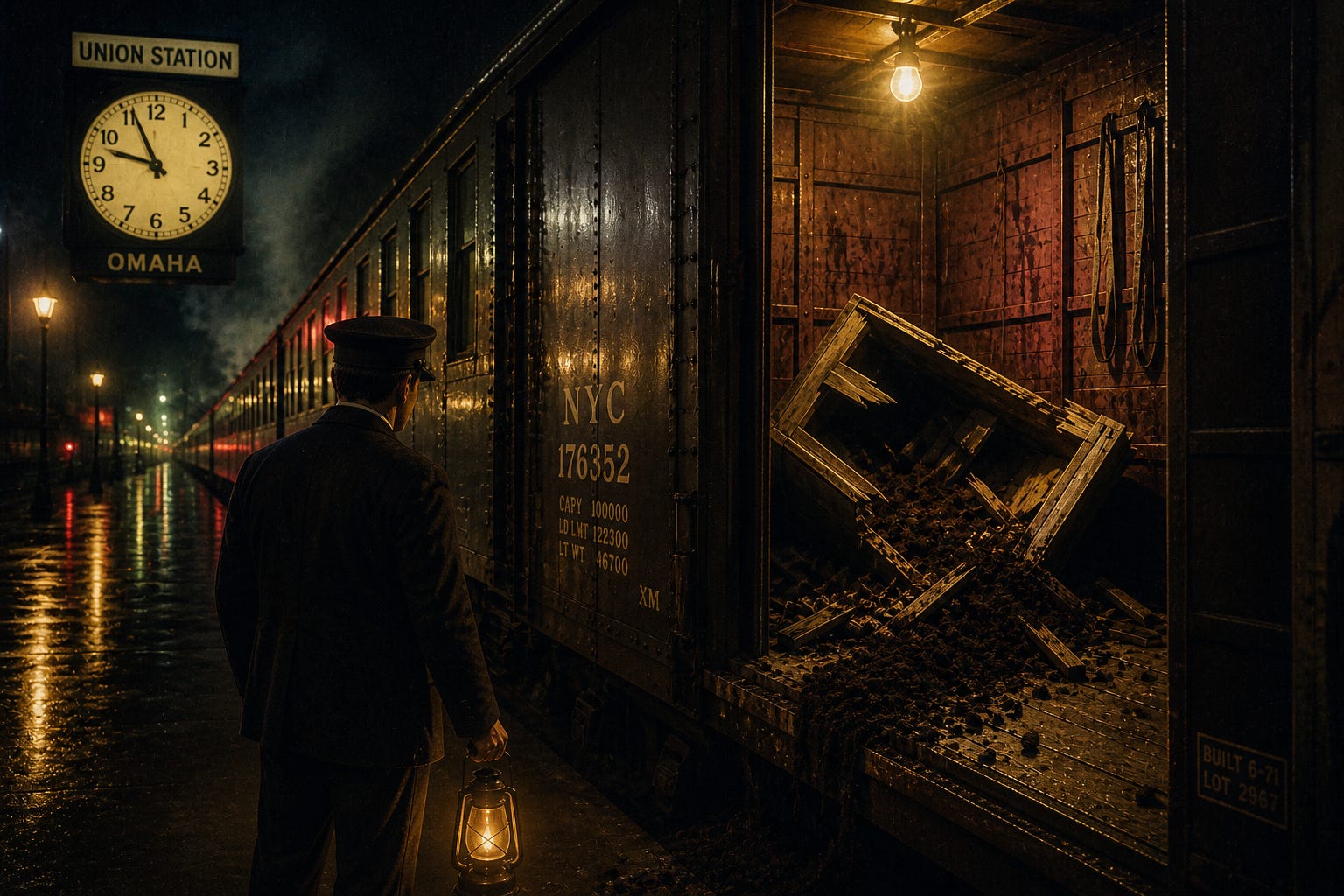
The following is a one-off short story that I have been playing around with, based on the ship voyage in Dracula. Let me know your thoughts in the comments! Thanks.
The platform clock read 9:57 when Frank Marsh initialed the freight manifest without reading it.
Twelve minutes behind. The Omaha-to-Chicago overnight, forty-six passengers already seated, and a loading crew that had taken twenty minutes on a single crate when it should have taken five. He pressed the clipboard back into the freight supervisor’s hands and turned toward the train.
“Heavier than listed.” The supervisor called after him. “And the smell”
“Log it.” Frank didn’t slow down.
The October platform bit through his uniform jacket. He walked the length of the train the way he always did before departure, a hand trailing along the cars, feeling for anything wrong. Everything solid. The dining car windows glowed amber. In the sleeper car, a shadow moved behind frosted glass. At the far end, past the last passenger coach, the cargo car sat low and dark on its couplings.
The light above its door flickered.
Frank noted it the way he noted all small malfunctions: filed, assigned a number, scheduled for the next maintenance window. A bulb. He had forty-six passengers and a twelve-minute deficit and a wife he’d promised to call.
The payphone by the station entrance was cold against his ear.
“Made it.” Linda’s voice carried the warmth of someone already half-asleep, reaching back from the edge of it just for him. “How’s the platform?”
“Cold. Busy.” He watched the freight supervisor write something on his clipboard. “I’ll be home by seven.”
“I’ll leave coffee.”
“Don’t wait up.”
He hung on the line an extra beat before hanging up, listening to the faint static between them.
Calvin Webb was working the dining car. He had a way of making each passenger feel specifically seen, a small and genuine gift that Frank had always thought was wasted on a railroad salary. Tonight, he was sliding coffee onto a corner table before the woman there had finished deciding she wanted it.
Frank caught his eye on the way through.
“We got a good crowd.” Calvin followed him toward the service counter. “Mostly quiet. There’s a fellow in coach two, older, European, who didn’t check any luggage. Watches. Carrying three of them.”
“Three watches.”
“All set to different times. I checked, and there was something the loading guys said, before we pulled — one of them thought he heard something in that back crate. Shifting around.”
Frank poured himself a coffee from the service pot. “Live freight gets routed to the livestock cars. That crate’s on the manifest as furniture.”
“Sure.” Calvin restacked a column of sugar packets that didn’t need restacking. “Probably just settling.”
“Probably.” Frank drank the coffee, set the cup down, and went to walk his coaches.
The old man was in the window seat of the second coach, third row from the rear. Small. Suit a decade out of style, freshly pressed. His white hair caught the overhead light, and his hands rested on a cloth-bound notebook in his lap with the deliberate stillness of someone long accustomed to waiting. Three watches — Frank counted them as he passed, two on a chain and one worn on the wrist, the face turned inward.
The man looked up as Frank drew even with his seat.
Frank gave him a conductor’s nod. Standard. Professional. The man returned it with something that wasn’t a nod so much as an acknowledgment, the look of someone who has been watching for a specific person and has just identified them.
Frank moved on.
At 10:31, the intercom in his conductor’s compartment crackled.
“Marsh.” Roy’s voice, flat with years of running the same lines. “Cargo door’s showing unlocked on my panel. Thought you’d want to know.”
Frank had his master key out before Roy finished the sentence.
He walked the train from front to rear, past sleeping passengers, past Calvin’s coffee, past the old man who was still awake, still watching the dark window, and through the vestibule connections where the night rushed in cold between cars. The coupling noise was a physical thing, a percussion in the sternum. Each connecting door he pushed through felt heavier than the last.
The cargo car smelled like soil and old wood.
He found the light pull and yanked. The single bulb lit. Pallets of mail. Strapped luggage. The crate, seven feet long, dark timber, stenciled markings in a language that wasn’t English, sitting against the rear wall where the loading crew had left it. The cargo straps were tight. The crate was intact. A mechanical latch fault, nothing more; he’d seen it a dozen times on older stock. He reset the door latch and locked up.
On his way back through coach two, the old man turned from the window.
“You’ve been to the back.” His English was careful and precise, each word placed with intention.
Frank stopped walking. “Routine check.”
The old man nodded once, slowly, as a doctor nods when a patient describes a symptom he already recognized three sentences ago. He turned back to his window.
Frank stood in the aisle for two seconds, listening to the wheels on the track, and then continued forward.
Calvin found him at 11:22.
Frank knew from the set of his shoulders before he reached the compartment door — Calvin was a man who moved toward people, opened conversations at distance, filled space with small easeful noises. The Calvin who appeared in the doorway was standing very still.
“Come with me.”
The cargo car door was open four inches. From inside: a dry shifting sound, slow and granular, like sand resettling in a glass.
Frank pushed the door fully open.
The crate was wrecked. Not broken into. The planks radiated outward from the center in long pale splinters, the cargo straps hanging from the walls in two clean pieces. Across the car floor lay a scatter of dark soil — dense, black, European — and it carried a smell he had no category for, something between cellar and stone and something older than both.
The crate was empty.
Frank stood in the doorway for a long time. Calvin stood behind him and said nothing.
The manifest was still in Frank’s jacket pocket. He pulled it out. Estate of D. Harker, c/o Carfax Import Co., New York, NY. Antique furniture — personal effects. The shipping name caught on something in his memory, a snag without a source, and he couldn’t pull the thread loose.
He folded the manifest and put it back.
“Nothing to the passengers.” His own voice sounded far away. “We do a full search, front to back, before we hit Millard Junction. Animal, vagrant, whatever got in that crate, we find it, we contain it, and we handle it before the stop.”
Calvin’s jaw worked. “Frank”
“Two hours to the junction. If we haven’t found anything by then, I call ahead, and we deal with it on the platform.” He turned to face him. “Can you keep this off the passenger frequency?”
Calvin looked at the empty crate. At the scattered soil. At the snapped straps.
“Yeah.” His voice was quiet but steady. “I can do that.”
Frank crouched. The soil was dense and cold and left a dark residue on his fingers. He pressed his palm flat against the car floor and felt the vibration of the track running up through his bones, the train carrying all of them forward at sixty miles an hour through a dark he couldn’t see the end of.
He was about to stand when he saw the footprint.
It was in the soil, a foot from his hand, and it was barefoot, and it was the size of a man, but the impression was too deep for the soil’s density, as if whatever left it had descended from a great height, and the toes had sunk deeper than the heel, and the stride that followed it led not to the door where Frank crouched, but to the rear wall of the car.
And stopped there.
Frank straightened slowly. The rear wall was solid. No door. No gap in the siding.
He looked at the wall for a long moment.
Then he stepped out of the cargo car and locked the door behind him, and the sound the deadbolt made, solid, mechanical, final, did nothing for the cold that had settled in below his ribs. He’d spent twenty-two years on these trains. He knew every sound they made, every fault and shudder and settling groan. He knew the difference between problems he could fix and problems that needed someone else.
He had never, in twenty-two years, found a problem he couldn’t name.
The train pushed forward into the Illinois dark, and behind him, locked in the cargo car, something just didn’t feel right to Frank. It was the same type of feeling people feel when they are being watched.
Strange an eerie feeling to feel you are being watched . Be glad to read chapter 2 to see where this is going .